
Artificial Intelligence
June 2026
How AI Is Transforming Modern Business Operations
Discover practical AI applications helping businesses improve efficiency and decision-making.
Introduction
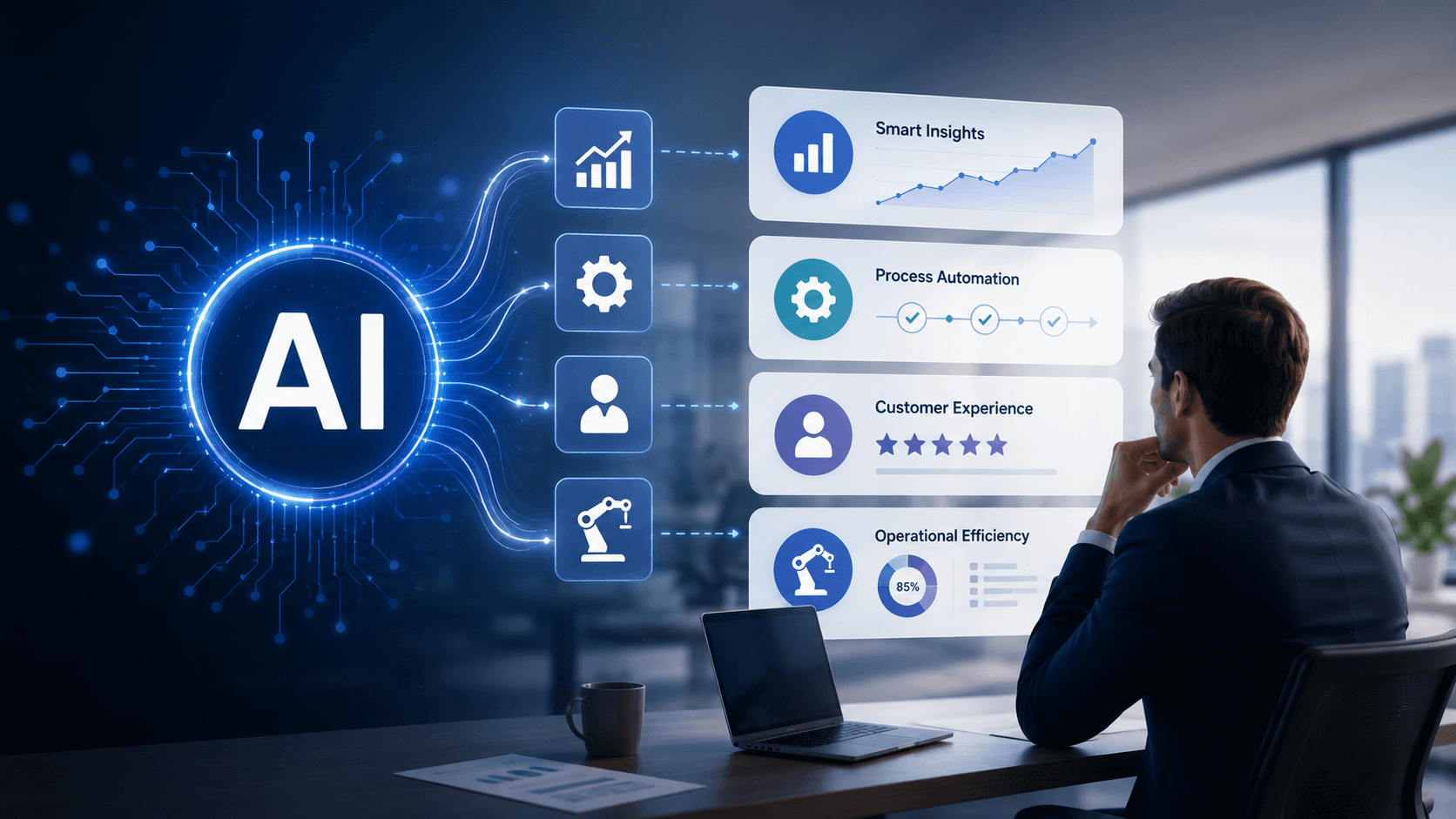
In 2026, AI is no longer a futuristic concept but a core business driver. Companies use AI solutions to automate tasks, personalize services, and make smarter decisions. Industry research shows that 73% of firms adopting AI report measurable efficiency gains, and AI-driven automation can cut support costs by ~30%. AI spans customer service, finance, supply chain, HR, and more. This blog explains why businesses invest in AI, highlights key use cases, and offers practical tips for successful adoption of AI for business growth and automation.
Why Businesses Invest in AI
Modern businesses face rising customer expectations and operational complexity. Customers now demand instant, personalized service 24/7, and companies juggle vast data across many channels. AI solutions meet these challenges head-on: they automate repetitive tasks, analyze large datasets, and operate at scale. For example, McKinsey estimates AI’s potential to add $4.4 trillion in productivity globally. Research finds that most adopters see results – 73% of companies using AI in operations report efficiency improvements. In short, AI accelerates productivity and innovation while cutting costs: Gartner predicts agentic AI will resolve 80% of common service issues by 2029, reducing operational costs by ~30%.
Key AI Use Cases in Operations
AI is transforming core business functions across industries. Here are a few examples:
Customer Service & Support: AI chatbots and virtual assistants provide 24/7 support. They instantly answer FAQs and route complex issues to human agents. Companies using AI chatbots report a 20–30% drop in support tickets. This means faster response times and happier customers. (Gartner predicts by 2029 AI will handle 80% of common inquiries, making service scalable.)
Sales & Marketing Automation: AI analyzes customer behavior and purchase history to target marketing and automate campaigns. It can score leads automatically and personalize outreach via email or messaging. This leads to higher conversion rates as sales teams focus on the most promising prospects.
Supply Chain & Inventory: Predictive analytics forecast demand and optimize stock levels. Retailers using AI forecasting cut inventory costs by 15–20% by avoiding overstock and stockouts. AI also monitors logistics risks (like shipping delays) in real time, enabling proactive adjustments.
Human Resources: AI streamlines recruiting and employee management. Tools automatically screen resumes for best-fit candidates and analyze employee sentiment and performance data. This automation frees HR teams from paperwork and lets them focus on strategic workforce planning.
Finance & Accounting: AI accelerates financial workflows. Automated systems process invoices, flag fraud, and reconcile accounts with minimal errors. Companies report 30–40% faster financial processing thanks to AI. Predictive models also forecast cash flow and spot anomalies before they become problems.
These use cases show how AI for business drives efficiency in multiple areas. Organizations that embrace AI-enabled automation and predictive analytics see measurable improvements in speed, cost, and accuracy.
AI in Action: Real-World Examples
Across industries, early adopters already see significant gains:
E-commerce: Online retailers use AI chatbots to answer customer questions and process orders instantly. One study found e-commerce businesses saw a 20–30% reduction in support tickets after adding AI chat support. This not only cuts costs but also boosts customer satisfaction by reducing wait times.
Retail & Manufacturing: Retail chains apply AI to predict demand and automate ordering. For instance, a major retailer reduced inventory costs by ~15% using AI-driven forecasting. Manufacturers use predictive maintenance: by analyzing sensor data, they schedule equipment servicing only when needed, avoiding downtime.
Financial Services: Banks and insurers deploy AI to speed up loan processing and detect fraud. Automated credit checks and document analysis allow loans to be approved days faster. In finance departments, AI tools reconcile transactions overnight, resulting in up to 40% faster closing cycles.
These examples illustrate tangible results: faster operations, lower costs, and better service. According to PwC and Forrester research, companies that integrate AI into workflows often see 20–35% productivity boosts and up to 30% cost savings in support and operations.
Implementation Considerations & Challenges
While AI offers clear benefits, successful adoption requires planning. Common challenges include:
Data and Infrastructure: AI needs quality data. Ensure data is clean, well-structured, and accessible. Integrating AI with existing systems (CRM, ERP, etc.) can be complex, so plan for any necessary data pipelines or cloud services.
Skills and Culture: Skilled AI professionals are in high demand. Start by training existing staff or partnering with an experienced AI development company. Cultivate a culture open to change; involve end users early to drive adoption and trust.
Ethics and Governance: Address privacy, bias, and compliance. Set clear policies for AI usage and regularly audit AI models for fairness and accuracy. Transparency in how AI decisions are made helps gain stakeholder buy-in.
Cost and ROI: AI projects require investment in tools and talent. Begin with a pilot on a high-impact use case, measure results, and scale gradually. Define success metrics (e.g. time saved, error reduction, revenue lift) to track ROI.
To manage these, follow an incremental approach: identify a promising use case, run a small pilot, then expand. The chart below outlines a typical AI adoption roadmap:
Discovery: Assess processes to find repetitive, data-rich tasks that AI can improve.
Pilot: Build a prototype on a chosen process and collect performance data.
Scale: Roll out successful pilots across departments or geographies.
Optimize: Continuously refine AI models based on feedback and new data.
Key Takeaways
Automate High-Volume Tasks: Use AI chatbots for support and AI scripts for routine tasks to free up employees for creative work.
Leverage Predictive Analytics: Apply AI to forecast demand, detect maintenance needs, or predict market trends for better decision-making.
Start Small, Then Scale: Launch AI pilots on critical processes first, measure impact, and expand gradually.
Focus on Data Quality: Ensure your AI models have clean, relevant data. Poor data leads to poor AI outcomes.
Align with Business Goals: Tie every AI initiative to a clear objective (cost reduction, faster service, higher sales, etc.) and track metrics.
Address Change Management: Involve teams early. Explain how AI tools benefit employees and customers to drive acceptance.
Ensure Ethics and Compliance: Implement governance to monitor AI decisions for fairness, privacy, and security.
Invest in Expertise: Partner with AI development experts (or train staff) to build effective, scalable solutions.
By following these best practices, businesses can harness AI solutions to transform operations safely and effectively.
Conclusion
AI for business is a powerful tool for innovation and efficiency. In 2026, companies adopting AI are seeing faster processes, smarter decisions, and stronger growth. If you’re considering AI for your organization, start with a clear plan and measurable goals. Partnering with an experienced AI development company can help you navigate the journey from strategy to results.
At DevelopDex, we specialize in AI solutions and business automation. We can help you identify the best opportunities, build pilot projects, and scale them across your operations. Contact us to learn how our AI expertise can transform your business operations in 2026 and beyond.
Suggested Reading: For more insights, see McKinsey’s AI workplace report, Gartner’s AI in customer service forecast, and industry AI trends.
By: DevelopDex Team
